|
|
|
|
|
|
|
|
|
|
|
|
|
|
|
|
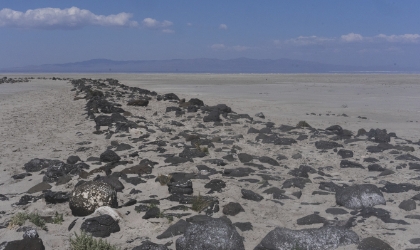
| Spiral Jetty, at the edge of the Great Salt Lake in Utah. |
|
| |
|
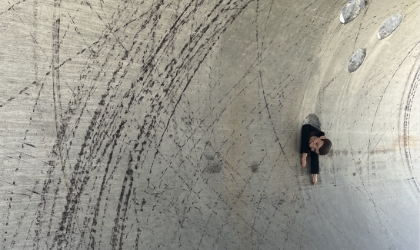
| This past summer Christine Mehring, Mary L. Block Professor of Art History, took 11 students—a mix of College and graduate students from last spring’s Earthworks Revisited course—on a tour of important works of land art. Over two weeks, Mehring and her students road-tripped through five states, seeing such pieces as City (1970–2022) by Michael Heizer and Spiral Jetty (1970) by Robert Smithson. |
|
| |
|
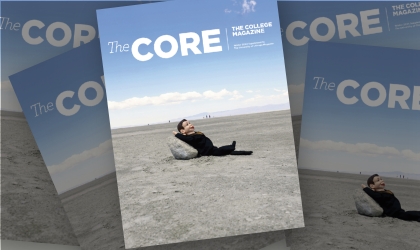
| In addition to numerous photos of land art, Mehring also shared images of Serra, who became the cover model for the Core’s Winter 2024 issue. |
|
| |
|
|
|
| Serra joined the group in Las Vegas. During a visit to a secondhand store, Sila Ulug, AM’23, a graduate student in art history and theater and performance studies, discovered Serra in a baby carriage and bought them (Serra’s pronouns are usually, but not always, “they/them”) for $60. |
|
| |
|
| After that, Serra accompanied the group everywhere. “It truly freaked everyone out,” says Mehring. |
|
| |
|
|
|
| Serra is not scary, Ulug insists (although one potential subletter of her Hyde Park apartment passed after spotting Serra in a closet). “Some people, when they see Serra, feel a little bit uncomfortable because they’re always smiling,” Ulug says. “Why are they so happy? These days it’s expected that everybody’s suffering from one thing or another, but Serra does not have those sorts of feelings.” |
|
| |
|
|
|
| Serra enjoys singing opera, Ulug says. They were singing about land art just before the cover shot was taken. “They tend to get excited all at once, so they’ll just burst into song,” Ulug says. “It’s just pure, earnest joy.” |
|
| |
|
|
|
|
|
|
|
| Elly Fishman, LAB’06, AB’10, revisits the SOSC course she took as an undergrad. |
|
| |
|
|
|
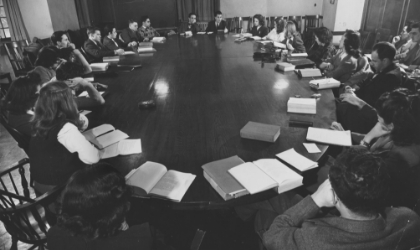
| That’s the question that Anirban Karak, collegiate assistant professor, asks the 18 students in Self, Culture, and Society I. |
|
| |
|
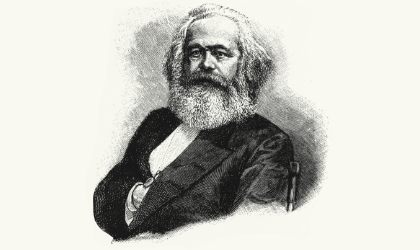
| Many answers could suffice in a broader conversation; in the context of Karl Marx, however, only one does. |
|
| |
|
| After a long pause, which Karak endures gracefully, a student raises his hand. “It’s the conflict between use value and value in any one commodity,” he says. “And how it appears as the external opposition between itself and money, but it’s actually internal opposition.” |
|
| |
|
| “Exactly,” says Karak. Fetishism is the value we assign to objects, which, in a capitalist society, is often expressed through the number on a price tag. |
|
| |
|
| A little over a month into the first quarter, today’s class remains an exercise in basic Marxian definitions. Use value: Usefulness of a commodity—as opposed to its exchange value. Labor power: Workers’ capacity to do work. Surplus value: Value created by workers that generates a profit for the capitalist. |
|
| |
|
| If this group of students is anything like my own classmates, eventually these same terms will serve as the basis of heated late-night arguments. (One common exchange in my College living room was whether our friend group could truly live collectively and communally within a capitalist society.) The phrases might also lend themselves to notable fashion choices like my former roommate’s, whose beloved baseball cap read “Necessary Labor Time” across the front. |
|
| |
|
| And if these students are anything like me—I took this same SOSC sequence in 2007—they will carry these first lessons with them for years to come. |
|
| |
|
|
|
|
|
|
|
|
|
|
Alumni: What do you remember most about your Core courses? Did you have an inspiring professor who changed your life? Did you earn your first C? Did you marry the student who sat next to you? Were you That Kid? |
|
| |
|
|
|
|
|
| Alumni memories: The shock of the new |
|
| |
|
| In the January issue, we asked alumni for stories of living in a brand-spanking-new residence hall. Longtime Core contributor Benjamin Recchie, AB’03, sent in the following dispatch. |
|
| |
|
|
|
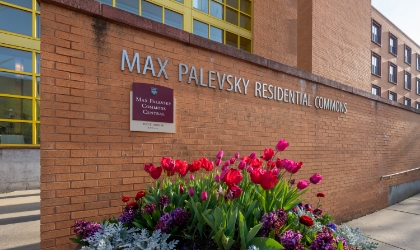
| In the fall of 2001, my friend Jonathan Lung, AB’03, and I moved into Hoover House, part of then-new Max Palevsky East. I occasionally noticed water pooling at the base of our toilet. It didn’t seem to smell bad—it was almost perfumed, if anything. |
|
| |
|
| But the water kept showing up more and more frequently, and in greater amounts. Then one evening I found Jon on his hands and knees, trying desperately to build a dam with towels. Water was burbling up from the base of the toilet like a fountain. |
|
| |
|
| We contacted our resident heads, and soon facilities staff came. I could hear the two men making light chitchat until they turned the corner and saw our flooded room, at which point one gasped and swore. (It was weirdly validating.) |
|
| |
|
| It turned out the main sewage outflow pipe had been installed with a kink. Any overpressure would push wastewater back out the nearest opening—apparently, the base of our toilet. Overpressure was commonly caused by multiple washing machines draining at the same time. This is why our mystery water smelled like perfumed laundry detergent. |
|
| |
|
| I presume when they finished our mirror image twin, Max Palevsky West, the next year, some engineer made a small but very important modification to the design. |
|
| |
|
|
|
| Previously in College Review |
|
| |
|
|
|
|
|
|
|
|
|
|
|
| The College Review, edited by Carrie Golus, AB’91, AM’93, is brought to you by Alumni Relations and Development and the College. |
|
| |
|
|
|
| (1) Claire Carcara, AM’23 |
|
| |
|
|
|
|
|
|
|
|
|